


Earn Back $1,500 Annually By Saving On Food With This Simple Tip


Much of our daily spending comes in the form of food, from buying groceries to eating out, so saving on food can make a big difference in our ability to hold onto more money for other areas.
Luckily, there is a simple tip that can help save us up to $1,500 on average every year in food. Are you ready for it? Here it is:
Throw out as little food as possible.
Now before you exit this article in fury, let me explain a little bit. The average American family throws out $1,500 in food every year, which means if we can reduce food waste, we can reap the benefits in savings.
Of course, this is much easier said than done (I said the tip was simple, not easy!) But I've been tackling this problem for a while now and have come up with some straightforward ways to reduce food waste that can also help us save money and even be healthier as a result.
Here are 10 easy ways to save money on food by reducing food waste.
1) Plan Out Your Meals

Meal planning is one of the most effective ways to both reduce food waste and save money. By planning ahead, we can plan out exactly which groceries we need to buy so we don't buy any more than we need, meaning we buy less superfluous stuff and therefore throw out less.
At the beginning of each week, my wife and I plan out what we're going to cook (and therefore eat) for the week. This also reduces the likelihood that we'll be stuck scrambling at 5:30pm wondering what we're going to make for dinner, only to just order in food (don't worry, we've all been there).
The more we all can plan ahead, the less unnecessary food we'll buy, thereby saving money and reducing food waste. This also has the added side benefit of allowing us to plan out healthy meals rather than relying on last-minute options, which tend to be less healthy.
2) Buy Only What You Will Use, Especially Perishables

Most of the food we throw out are perishables. This makes sense of course - they're the foods that expire fastest after all - but that's why it's extra important that we buy only the perishables that we think we'll use. If we don't have a specific use in mind for it, we probably shouldn't get it.
Sure, there may be times where we accidentally buy a bit more than we need (we'll talk more about that later). But try to only buy what you know you're going to use. If you're not sure you're going to eat it, either skip it or opt for a lower quantity instead (I'm looking at you, fellow Costco lovers).
3) Get Comfortable With Leftovers

So much food is thrown out every day simply because we don't feel like saving it, and for many people this boils down to simply not liking leftovers.
And look, I get it. I used to hate leftovers myself. At one point I even refused to eat microwaved food - I told people it was due to a (largely unfounded) fear of the microwave's radiation, but really I was just a snob about leftovers.
However, leftovers are not just a great way to save food: they're a huge time saver as well. All of the cooking and prep work is already done: the only thing we have to do is take it out of the fridge (or freezer), pop it in the microwave, and boom. We're good to go.
I went from hating leftovers to meal prepping all of my dinners on Sundays and eating pretty much exclusively leftovers throughout the week. Granted you don't need to be that extreme, but the point still stands: leftovers rule, and they save on time, money, and food waste.
4) Invest In Reusable Food Storage Containers

Because you'll be saving a lot more leftover food, you're going to want to invest in quality food storage options in the form of glassware, Tupperware, or reusable bags.
By owning a robust set of food storage containers, you'll be able to store foods of any type or quantity, either for leftovers or to keep produce fresh for use in a future cooking endeavor.
My wife and I have several sets of Pyrex glassware as well as a set of Stasher silicone bags that we use to store leftovers as well as produce that has been cut into. These work superbly for us, and I'd recommend them to anyone.
While any food storage container will do, I personally notice a big difference between putting leftovers in a low-quality plastic container versus a nice piece of glassware with a silicone lid. It makes the leftovers feel more appetizing, increasing the chances I'll actually eat them.
5) Familiarize Yourself With Produce Storage Best Practices
Every type of fruit and vegetable stays fresh for a different amount of time, and they all have their own unique ways to maximize their freshness. By learning these best practices, we can ensure our produce lasts the longest amount of time possible, thereby reducing the need to throw out produce.
I've embedded an incredible infographic that reviews the best way to store many of the most common vegetables.
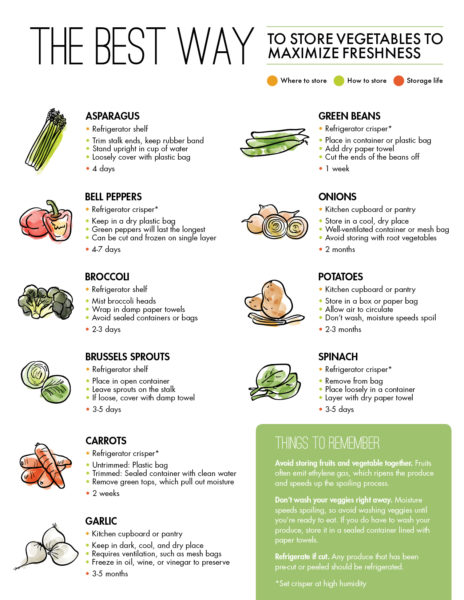
Many vegetables, such as asparagus, broccoli and spinach, should be placed immediately in the refrigerator either in the crisper or on the shelf (it varies from veggie to veggie). These veggies generally only last between 3-14 days in the fridge. Other vegetables, such as potatoes, onions, and garlic, can safely be left out for months.
Regarding fruits, they usually ripen (and therefore spoil) less quickly in the fridge. So if you have a fruit that is ripe, you should put it in the fridge so that it will last longer.
A few general tips: you shouldn't store fruits and vegetables together, as fruits emit certain gases that can make vegetables spoil more quickly. Also if you cut any of your fruits and vegetables, you should put it in the fridge as soon as you're done because cut produce lasts a much shorter time than if it weren't cut.
For more information on how to maximize the freshness of grocery items, check out the FoodKeeper section of FoodSafety.gov, which contains detailed food storage instructions for a huge variety of common grocery items.
6) Take Expiration Dates With A Grain Of Salt

Most foods have dates on the packaging signifying the date before which that food is best by. While these are certainly good indicators of when food will spoil, they are certainly not perfect.
We shouldn't throw out food just because the expiration date has passed, especially if it's still sealed or unopened. I once had a sealed container of cottage cheese that was a week past its expiration date, but it looked (and tasted) perfectly fine. The expiration date should generally be used as a guideline rather than a hard and set rule.
Of course, if a food smells funky or you're genuinely concerned that it might be unsafe for you to consume, don't force yourself to eat it just to save money. But oftentimes food will still be good to eat past its expiration date, so use your discretion.
7) Prioritize Cooking Ingredients That Are About To Spoil

Let's say we have a choice between cooking broccoli or bell peppers, but there's one key difference: the broccoli is going to spoil by tomorrow, whereas the bell peppers will last a few more days. Given this choice, we should cook the broccoli tonight, even if we were looking forward to the bell pepper dish, so we can eat the broccoli while it's still fresh rather than throw it away.
Cooked food also lasts longer than raw food. So even if we cook nearly-spoiled food just to save or freeze it later, we're still increasing the lifespan of the food, thereby increasing the odds that we'll actually eat it later.
In general, we should plan to cook the items that we know are going bad soonest in order to waste as little food as possible and therefore save money over the long run.
8) Freeze Perishables Before They Go Bad

Let's face it: we all sometimes buy or store more food than we can actually eat before it goes bad. It happens. But rather than throwing it out, opt for a different path instead: freezing the perishable food.
I'll admit that before I met my wife, I had no idea just how much food you can actually freeze. Everyone knows you can freeze things like meat, but I used to throw out leftovers that had simply been sitting in the fridge for too long. Little did know, however, that you can actually freeze pretty much anything before it goes bad and defrost it days or even weeks later to enjoy.
The sooner you freeze food, the longer it will stay good and the better it will taste when you unfreeze it. Granted, it's not going to taste as good as when it's freshly cooked, but it can easily save you in a pinch when you want to eat something quick but don't want to go through the hassle of cooking or ordering food.
This is also why it's important to have a lot of reusable food storage options: it makes it much easier to freeze leftovers.
9) Turn Ugly Produce Into Smoothies And Soups

We've all been there. We excitedly buy fruits or vegetables, only to find that after a day or two it has deformed in some way. It's not that it's unsafe to eat, but it just looks or feels unappetizing.
It might be your instinct to throw such produce away, but there's a better solution: turn it into soup or smoothies. When it's pureed, you don't notice the deformities, and it tastes just as good as a fruit or vegetable that isn't deformed.
I will often throw old bananas (or better yet, old frozen bananas) into a post-workout smoothie for some added flavor. My wife has also made soup out of cauliflower that was about to go bad but that we knew we weren't going to eat (she then promptly froze the soup so we could eat it when one of us got sick).
After all, who doesn't love a good soup or smoothie?
10) Buying Less Food = Saving On Food

This last item on the list may ruffle some feathers but it's worth noting: one of the simplest ways to waste less food is simply to buy less food.
Too often, we over-order at restaurants or overspend at grocery stores because we succumb to our desires in the moment. But if we plan to order less, we'll likely only order what we actually need to eat, reducing all the unnecessary fluff down to what really matters. And by ordering less food, we're implicitly less likely to waste as much food because there will be less food to actually waste, thereby saving us money.
In addition to saving on money and food waste, ordering less food also has the byproduct of encouraging us to eat lower quantities. This, if done in moderation, can help us reduce our body fat percentage, which itself has myriad health benefits.
Conclusion
Every piece of edible food you throw out is food that you've already paid for, which means by throwing out food, you're ostensibly throwing out money.
Instead, we can use these tips to maximize the food we purchase so that we throw out less food waste and therefore save money.
Do you have any food waste tips that you believe should be added to this list? Let us know in the comments below!


Comments